
ValhallaFutureVerb: The 'Perfect' Reverb That Changes Everything
After eight years of development, Valhalla DSP finally dropped something that had the entire production community buzzing: ValhallaFutureVerb. And honestly? The hype is justified. This isn't just another reverb plugin- it's a complete rethinking of how reverb and delay should work together in your mix.
At just $50, it's positioned as the new standard for producers who refuse to compromise on quality. Let's break down what makes this plugin worth your attention.
Eight Years of Research, Finally Here
Valhalla DSP doesn't rush things. The company spent nearly a decade perfecting ValhallaFutureVerb, and you can hear it in every algorithm. The result? Reverb algorithms that are "as close to perfect as we have ever heard," according to industry reviewers.
The core promise is simple but powerful: transparent, realistic reverb without the metallic artifacts that plague most digital algorithmic reverbs. Whether you're working with vocals, synths, or drums, FutureVerb captures natural space acoustics across eight distinct reverb algorithms.
Five of these algorithms model realistic spaces - rooms, plates, and halls - while the remaining three venture into experimental territory with modes like Frozen and Nonlin. This gives you the flexibility to go from subtle to completely otherworldly, all from one plugin.
Twelve Echo Modes: Your Secret Weapon
Here's where FutureVerb gets interesting. The reverb section is clean and transparent, but Valhalla knew that meant adding character elsewhere. Enter the echo system.
Twelve echo modes give you granular control over how delay interacts with your reverb. You've got your classics - Tape, Digital, Analog, and LoFi - that add vintage warmth. Then there are the experimental modes like Sparkle and Swarm, which use detuned granular delays to create lush, textured ambience that sounds nothing like traditional delay.
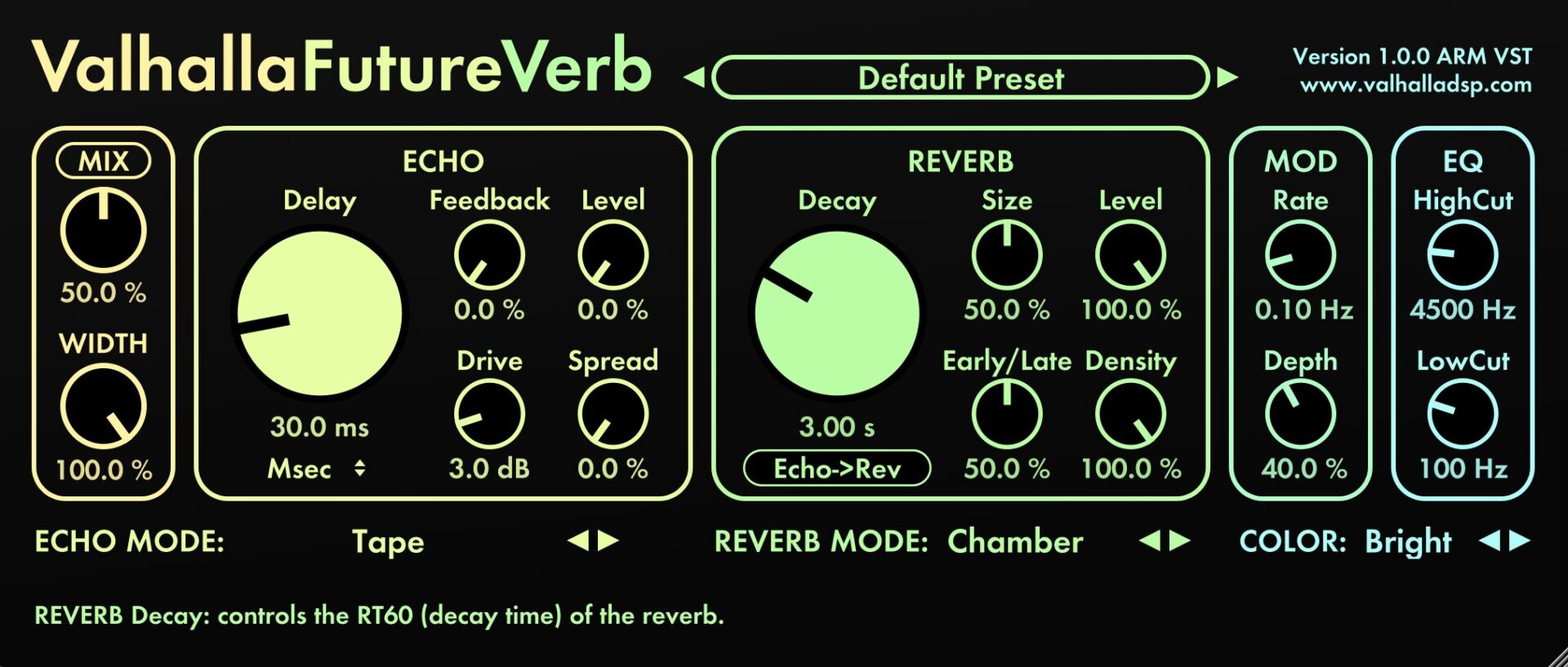
The echo section can sit before or after the reverb, letting you use it as a pre-delay or push the reverb output into completely extreme territory. The new Spread control is a game-changer too - it morphs simple stereo echoes into complex 4 or 8-delay feedback networks that create multitap sounds and richly textured reverbs.
Color Mode: One Control, Maximum Flavor
This is where design meets functionality. FutureVerb's Color Mode isn't just EQ presets - it's four intelligent frequency response profiles that shape your reverb's entire character.
You've got four options:
- Bright: Minimal high-frequency attenuation, perfect for synth reverbs where your filters control the tonality
- Neutral: Physically realistic high-frequency decay, the balanced choice for most sources
- Dark: An 8 kHz high-cut filter for darker, more vintage vibes
- Studio: Low cut at 600 Hz and high cut at 10 kHz for punchy, controlled reverb
Best part? The GUI actually changes color to match your selection, giving you visual feedback that reinforces what you're hearing. Small touches like this show the care Valhalla put into this plugin.
Hands-On Controls That Actually Matter
FutureVerb's interface strikes a perfect balance. You get powerful sound-shaping without drowning in options. Both the echo and reverb sections share fundamental controls: Mix (with a helpful mix lock button), Width, Mod Rate and Depth, and Low/High EQ.
Everything is designed for maximum sonic control with minimal complexity. Tempo sync is available for rhythmic precision, and the adjustable drive control lets you add grit when you want it. Internal modulation, feedback control, and density/reverb size adjustments are all right there, accessible and musical.
Navigation is intuitive too - previous/next arrows let you browse reverb modes, delay modes, colors, and presets without touching a dropdown menu. For mouse-over learners, tooltips appear at the bottom of the GUI. It's self-documenting design done right.
Why This Matters for Your Production
Let's get real: your reverb choice shapes everything. A muddy reverb tanks your mix. A cheap digital reverb makes your synths sound plastic. FutureVerb solves both problems.
For melodic techno and house producers, FutureVerb's transparency means your sounds stay defined in the mix while gaining that essential sense of space. The echo modes add character without eating up frequency real estate. For ambient and experimental work, the experimental reverb modes paired with Sparkle and Swarm delays unlock textures that are genuinely hard to find elsewhere.
At $50, it's an absolute steal. You're getting the sonic quality of plugins that cost five times as much, wrapped in an interface that makes you want to explore and create.
Technical Specs You Need to Know
FutureVerb runs on macOS 10.9 or higher (with full Apple Silicon support) and Windows 7 or higher. It's available as VST, VST3, AAX, or AU in 64-bit format. The package includes several inspiring presets to get you started, but the real magic happens when you start tweaking.
Whether you're a bedroom producer experimenting with sound design or a semi-pro looking to upgrade your reverb game, ValhallaFutureVerb delivers professional-grade results without breaking the bank.
The future of reverb isn't about more algorithms or flashier interfaces - it's about getting out of your way and letting you create. Eight years of development finally made that happen.