
Omnisphere 3: The Ultimate Virtual Instrument for Electronic Producers
After a decade of waiting, Spectrasonics has finally released Omnisphere 3, and honestly, it lives up to the hype. This is not a simple version number bump. It represents a fundamental evolution of what many consider the most powerful virtual instrument available, packed with features that will change how you approach sound design and production.
Whether you are grinding in the studio on a new melodic techno track or performing live with a hardware controller, Omnisphere 3 brings meaningful upgrades that address what producers have been asking for since version 2. Below we break down what is new and why it matters for your setup.
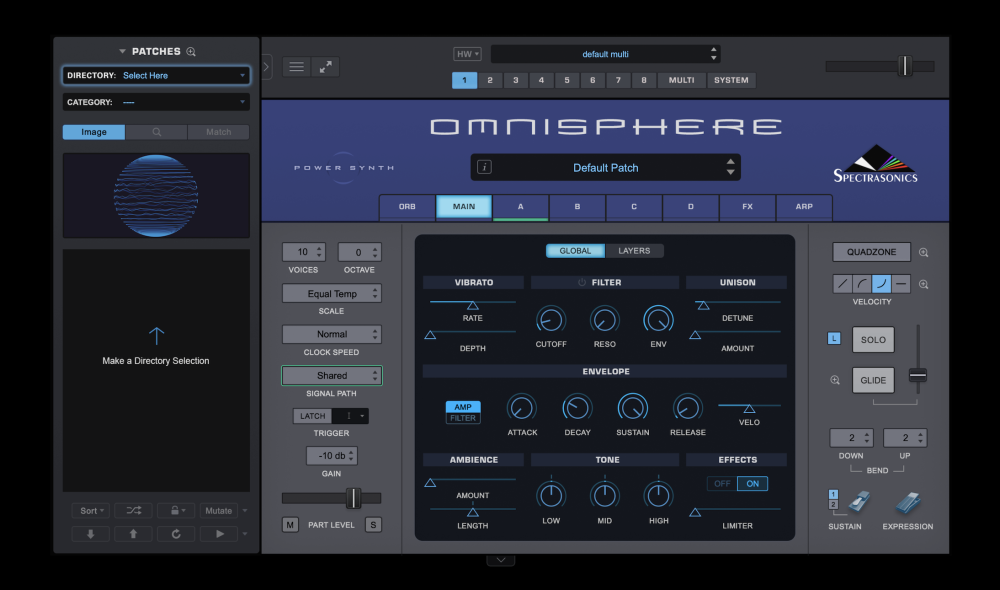
A Massive Sound Library Built Smart
First thing that hits you is the scale: Omnisphere 3 now contains over 26,000 patches across 18 curated libraries, plus thousands of fresh new sounds. That is massive. Yet the library size stayed at 64GB despite all this new content, which matters if you are managing limited SSD space.
Spectrasonics did not just record terabytes of new samples. Instead, they used the upgraded engine to reimagine their existing catalog. New filters, modulation options, and expanded effects deliver a much larger sonic palette from material that is already on your drive.
The sound design approach is intentional. Patches are heavily processed and "mix-ready" out of the box, making Omnisphere an exceptional inspiration tool. One patch can spark an entire track’s direction, and you can always toggle individual layers and effects on or off if you need to dial things back in dense mixes.
Creative Tools That Make Sound Design Intuitive
Two new features really stand out for how you will work with sounds: Patch Mutations and the Quadzone engine. Both change the workflow from preset browsing to deeper experimentation.
Patch Mutations is intelligent randomization on steroids. Rather than chaotic parameter shuffles, Mutations analyzes the patch structure and makes musical changes, swapping sound sources or wavetables for intelligent alternatives. You can set the intensity from subtle variation to extreme transformation, and every mutation saves automatically so you do not lose happy accidents.
This also works as a learning tool. Generate a mutation, then deconstruct it layer by layer to see what Spectrasonics’ sound designers did. It is ideal if you are trying to move from preset browsing to real sound design experimentation.
Quadzone turns Omnisphere into a serious performance instrument. It gives you an intuitive interface to control the four sound layers in any patch across three modes: Notes for keyboard splits and crossfades, Velocity for dynamic response, and Fader for smooth layer blending using MIDI CC, LFO, envelope, or polyphonic aftertouch. If you perform live or want more control during recording, this is a game changer.
Hardware Integration and MPE: Bridge the Gap Between Digital and Physical
This is where Omnisphere 3 separates itself from competitors. Over 300 pre-mapped hardware profiles mean your synths and MIDI controllers from Roland, Korg, Yamaha, Moog, Arturia, Novation, and Native Instruments map to Omnisphere parameters automatically. Touch the filter cutoff on your hardware and Omnisphere responds instantly with bi-directional integration that few plugins match.
If you have been waiting for MPE support, it is included. Full MIDI Polyphonic Expression support lets users of Expressive E Osmose, ROLI Seaboard, or Linnstrument unlock per-note expressive control. Individual pitch bends, polyphonic aftertouch, and timbre modulation for each note in a chord independently make many Omnisphere patches feel deeply organic and expressive when MPE is enabled.
The Analog Authenticity You Have Been Waiting For
Omnisphere 3 leans further into authentic analog character with features designed for serious sound designers. Vintage Oscillator Drift adds subtle random pitch fluctuations reminiscent of classic hardware. The 36 new filter types include component-modeled saturation that brings warm, harmonic coloration.
Classic Glide Modes now emulate legendary synths such as the Minimoog, Oberheim OB-Xa, ARP Odyssey, and Yamaha CS-80. There is also a polyphonic Dual Frequency Shifter, the world’s first in a plugin, which tracks the keyboard and applies unique frequency shifts to each note independently. If you are chasing analog character in digital form, these additions are significant.
The FX Rack: A Complete Studio Inside Your DAW
The effects engine received a major overhaul. Omnisphere 3 now includes 93 total effect processors, with 35 brand new units focused on character, vintage warmth, and creative options. That includes four types of reverb, such as Super Verb and Velvet Verb, four delay types, a 1176-style limiter, tube saturation emulators, multiband compression, and console EQs modeled after British and Class-A hardware.
Creative effects expand your possibilities further with tools like Flip Backward, Pump-O-Matic, Warp Shifter, and Chameleon Chorus. You can chain these together and apply them to patches, individual layers, and auxiliary sends. For many producers, this means fewer external mixing plugins are necessary, since the FX Rack acts like a plugin within a plugin.
Pricing and What This Means for Your Setup
New purchase price is $499, and upgrades from version 2 are $199. Given what you get, the value proposition is strong. You are essentially getting a complete hardware synthesizer emulation library, a mixing console’s worth of effects, and performance tools that rival dedicated hardware controllers, all in one plugin.
Whether you produce melodic techno, progressive house, or experimental electronic music, Omnisphere 3 gives you tools to create sounds that stand out. The combination of 26,000 plus patches, 93 effects, hardware integration, and the new creative features means you will spend more time making music and less time digging through menus.
If you have been using version 2, the upgrade is worth serious consideration. If you are new to Omnisphere, this is a great time to jump in. The plugin has matured into something special.